Equal Temperament
Every interval on a piano except the octave is deliberately, permanently slightly wrong. Musicians agreed to this in writing, and it bought the ability to change key.
Also known as: 12-TET · Twelve-Tone Equal Temperament · Well-Tempered · Temperament
EQUAL TEMPERAMENT — THE TRADE WITH A RECEIPT
UET Library Encyclopedia Entry
| Alignment Score | Tier | Category |
|---|---|---|
| 88% | ENGINEERED | Sound & Frequency |
Classification: Tuning system | Deliberate standardization | Documented trade-off Primary Designation: Twelve-tone equal temperament | 12-TET | Equal division of the octave Period: Calculated 1580s · argued in print from 1691 · dominant by about 1800 Current Status: The default tuning of nearly every fixed-pitch instrument on earth
EXECUTIVE SUMMARY
Twelve-tone equal temperament divides the octave into twelve mathematically identical steps. Each step is the twelfth root of two — about 1.0595 — so twelve of them multiply back to exactly 2, and the octave closes perfectly. Every other interval pays for that closure. None of them lands on the whole-number frequency ratio that produces a beatless, consonant sound.
This is the most important entry in the Library's narrowing material, and it is the one that most resists the simple version of the story. Nothing here was hidden. Equal temperament was calculated, published, argued over for a century, and adopted by people who knew exactly what they were giving up and said so in print. What they bought was the ability to change key freely on a fixed-pitch instrument, and to build, tune and teach those instruments interchangeably across a continent.
Compression is a trade. Here the receipt survives.
THE ARITHMETIC
A musical interval is a frequency ratio. Doubling a frequency gives the octave; the ear hears the two pitches as the same note. The simple ratios inside that octave are the consonances:
| Interval | Just ratio | Why it sounds clean |
|---|---|---|
| Octave | 2:1 | Every second wave coincides |
| Perfect fifth | 3:2 | Every third and second wave coincide |
| Perfect fourth | 4:3 | Coincidence every fourth and third |
| Major third | 5:4 | Coincidence every fifth and fourth |
Tuning by these ratios is called just intonation, and it sounds better than equal temperament on any single chord. Its problem is that the ratios do not close. Stack twelve perfect 3:2 fifths and you arrive slightly above where you started — the discrepancy is called the Pythagorean comma, about 23.5 cents, roughly a quarter of a semitone. The circle of fifths is not a circle. It is a spiral.
Equal temperament closes it by force. Each semitone becomes exactly 100 cents, where a cent is one hundredth of a tempered semitone and an octave is 1200 of them.
THE COST, MEASURED
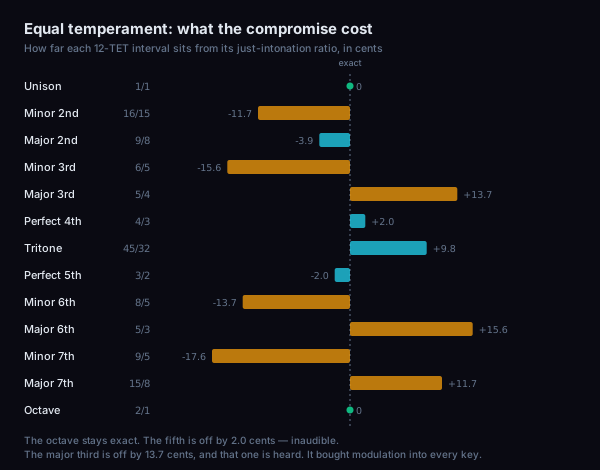
Deviation of each 12-TET interval from its just ratio, in cents. Positive means the
tempered interval sits sharp of the natural one. These figures are computed, not quoted —
the figure above and this table are generated from the ratios by
scripts/generate-music-notation-figures.mjs.
| Interval | Just ratio | Just (cents) | 12-TET | Deviation |
|---|---|---|---|---|
| Unison | 1/1 | 0.00 | 0 | 0.00 |
| Minor 2nd | 16/15 | 111.73 | 100 | −11.73 |
| Major 2nd | 9/8 | 203.91 | 200 | −3.91 |
| Minor 3rd | 6/5 | 315.64 | 300 | −15.64 |
| Major 3rd | 5/4 | 386.31 | 400 | +13.69 |
| Perfect 4th | 4/3 | 498.04 | 500 | +1.96 |
| Tritone | 45/32 | 590.22 | 600 | +9.78 |
| Perfect 5th | 3/2 | 701.96 | 700 | −1.96 |
| Minor 6th | 8/5 | 813.69 | 800 | −13.69 |
| Major 6th | 5/3 | 884.36 | 900 | +15.64 |
| Minor 7th | 9/5 | 1017.60 | 1000 | −17.60 |
| Major 7th | 15/8 | 1088.27 | 1100 | +11.73 |
| Octave | 2/1 | 1200.00 | 1200 | 0.00 |
What the numbers say. The octave is exact — that is the one interval equal temperament refuses to compromise. The perfect fifth is off by 1.96 cents, which no one hears; the just-noticeable difference for pitch in this range is several cents. The major third is off by 13.69 cents, and that one is audible to a trained listener and unmistakable when two instruments sustain it. Tempered thirds beat.
So the honest summary is not "everything is out of tune." It is: the octave was protected, the fifth was made imperceptibly worse, and the third was sacrificed.
WHAT IT BOUGHT
Three things, all real:
- Modulation into any key. On a justly tuned keyboard, a piece can sound beautiful in the key it was tuned for and unusable three keys away. Equal temperament makes all twelve keys equally serviceable, and equally slightly wrong. Bach's Das wohltemperirte Clavier (1722) is a demonstration: preludes and fugues in all twenty-four major and minor keys, written to be played on one instrument without retuning.
- Interchangeable instruments. A tuning standard is a manufacturing standard. Fixed fretting, fixed valve lengths, mass-produced pianos and an orchestra assembled from instruments made in different countries all require agreement about where the notes are.
- Teachability. Twelve identical steps can be taught as a system. Twenty-two unequal just positions must largely be taught by ear, from a teacher, over years.
The second and third of these are the same mechanism the Library's other narrowing material describes: the compression that wins is the one that reproduces fastest.
WHO ARGUED IT, AND WHEN
Calculated independently, twice, in the 1580s. Prince Zhu Zaiyu in Ming China described the twelve-fold equal division of the octave in 1584, and Simon Stevin in the Low Countries worked out the same division at almost the same time. This is convergence, not transmission: two mathematical traditions reached the identical answer because the arithmetic has one answer. The Library does not claim either influenced the other, and no evidence of contact is offered here.
Argued in Europe through the following century. Vincenzo Galilei — Galileo's father — was already writing about fretted-instrument temperament in the 1580s. Andreas Werckmeister published tempered systems in 1691. Through the same period the study of sound itself moved from the quadrivium into physics: Mersenne's Harmonie universelle (1636), and Sauveur coining the word acoustique in 1701.
Dominant by about 1800. Adoption was gradual, uneven by country and by instrument, and contested the whole way. Organs held out longest.
WHAT IT DISPLACED
- Just intonation — pure ratios, beautiful in one key, unusable across many.
- Pythagorean tuning — built from pure fifths, with a badly sharp major third.
- Meantone temperaments — the dominant Renaissance compromise, with excellent thirds bought by leaving one fifth wildly out of tune. That interval is called the wolf fifth, and its name records what musicians thought of it. Meantone keyboards worked in a limited set of keys and howled outside them.
Meantone is the detail that makes the story honest. Equal temperament did not replace purity with compromise. It replaced a compromise with a sharp edge by a compromise spread evenly. What was lost was not perfect tuning; it was the option of being perfectly in tune somewhere, at the price of being unusable elsewhere.
THE NARROWING READ, AND ITS LIMIT
Equal temperament fits the Library's narrowing model precisely — a standardizing institution compresses a rich, local, ear-transmitted practice into a portable notation and a manufacturable instrument, and what the new system cannot represent leaves the syllabus. Vocal ensembles, string quartets and unfretted traditions still bend toward just intervals because they can. Fixed-pitch instruments cannot, and fixed-pitch instruments became the teaching instruments.
The limit, stated plainly: this narrowing bought something specific and large, the argument happened in public, and the people who made it were musicians rather than administrators. Any reading that presents equal temperament as a loss imposed on musicians from outside is contradicted by the sources. The correct claim is narrower and more interesting:
Compression is a trade, the trade was probably worth it, and the institution that makes it decides what gets spent. Nobody voted on which intervals to lose.
WHAT WOULD CHANGE THIS ENTRY
- Evidence that adoption was driven by manufacturers rather than musicians would shift the emphasis considerably. The pattern exists elsewhere in this domain — see Concert Pitch, where the American standard was advocated by a tuning-fork manufacturer. No equivalent evidence is in hand for temperament, and this entry does not imply one.
- A controlled listener study showing audiences cannot distinguish tempered from just thirds in ensemble context would weaken the "audible sacrifice" claim. The 13.69-cent figure is arithmetic; what listeners actually notice is an empirical question this entry does not settle.
- Firmer dating on Zhu Zaiyu and Stevin, from primary texts rather than secondary accounts, would move the independent-derivation claim from documented to empirical.
SOURCES
| Source | Type | Year |
|---|---|---|
| Werckmeister, Musicalische Temperatur | Primary | 1691 |
| J.S. Bach, Das wohltemperirte Clavier | Primary | 1722 |
| Mersenne, Harmonie universelle | Primary | 1636 |
| Barbour, Tuning and Temperament: A Historical Survey | Academic | 1951 |
| Duffin, How Equal Temperament Ruined Harmony | Academic | 2007 |
Cents figures: computed from the just ratios in this entry by
scripts/generate-music-notation-figures.mjs. To correct a number, change the rule in the
script; do not edit the figure.
RELATED ENTRIES
- Concert Pitch — the other tuning standard, and the one where a manufacturer's interest is documented
- 432 Hz vs 440 Hz — what happens to this material when it leaves the evidence
- The Church Modes — the same reduction, three centuries earlier
- What Notation Cannot Write — the intervals a twelve-step system has no symbol for
This entry treats a narrowing whose full cost is documented and whose benefit is documented too. Both are reported. The Library's position is that this is the strongest case in the narrowing material precisely because nothing about it was concealed.
Appears in
- Cymatics · exhibit
- Deep time spine · 12-tone equal temperament dominant, text
Further reading
- Tuning and Temperament · Barbour, 1951
Links go to Bookshop.org, which supports independent bookstores. We may earn a commission, at no cost to you.
Related entries
Civilizational Science
Energy, food, money and the long patterns underneath them. Every claim carries its source and its evidence tier. Free, and it stays free.
No charge, and no paywall on the dispatches. Unsubscribe in one click.