Government and Cybernetics
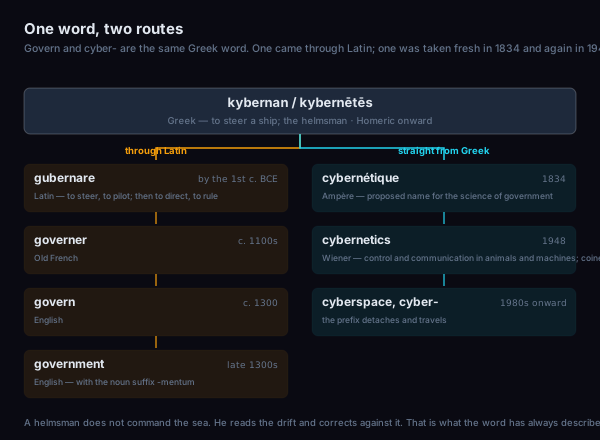
Govern and cyber- are the same Greek word — kybernan, to steer a ship. One came through Latin two thousand years ago; the other was taken fresh in 1834 and again, independently, in 1948.
Also known as: Kybernetes · Gubernare · Cybernetics · Steering · Ampère cybernétique · Wiener
GOVERNMENT AND CYBERNETICS — ONE WORD, TWO ROUTES
UET Library Encyclopedia Entry
| Alignment Score | Tier | Category |
|---|---|---|
| 86% | ENGINEERED | Etymology |
Classification: Word history | Documented derivation | Independent coinage, twice Primary Designation: kybernan → gubernare → govern · kybernētēs → cybernétique (1834) → cybernetics (1948) Status: Every link in the chain is attested in standard etymological reference; the two modern coinages are independent of each other
EXECUTIVE SUMMARY
Govern and cyber- are the same Greek word. The Greek is κυβερνᾶν (kybernan), to steer a ship, and κυβερνήτης (kybernētēs), the helmsman. Latin borrowed it as gubernare — to steer, to pilot, and by extension to direct or rule — and from Latin it came through Old French into English as govern around 1300 and government in the late 1300s.
Then it was taken from the Greek again, fresh, twice. In 1834 André-Marie Ampère proposed cybernétique as the name for the science of government, returning deliberately to the steersman image Plato and Aristotle had used for the state. In 1948 Norbert Wiener, unaware of Ampère, coined cybernetics for the new science of control and communication in animals and machines.
So the word entered English by one route two thousand years ago and by a second route in the twentieth century, and both times it meant the same thing: steering. Not commanding. Steering — reading the drift and correcting against it. The word government has been describing a feedback-control system for as long as it has existed.
THE CHAIN, LINK BY LINK
| Step | Word | Language | What it meant | When |
|---|---|---|---|---|
| 1 | kybernan, kybernētēs | Greek | to steer a ship; the helmsman | Homeric onward |
| 2 | gubernare, gubernator | Latin | to steer, to pilot → to direct, to rule; the helmsman → the governor | by the 1st century BCE |
| 3 | governer | Old French | to steer, to rule, to direct | c. 1100s |
| 4 | govern | English | to rule, to direct | c. 1300 |
| 5 | government | English | the act or system of governing — with the Latin noun suffix -mentum | late 1300s |
| 6 | cybernétique | French (Ampère) | the science of government, the art of governing | 1834 |
| 7 | cybernetics | English (Wiener) | control and communication in the animal and the machine | 1948 |
| 8 | cyber- | English | the prefix detaches — cyberspace, cybersecurity | 1980s onward |
Steps 1–5 are one continuous descent. Steps 6 and 7 each go back to step 1 directly.
THE STEERING METAPHOR WAS ALREADY POLITICAL IN GREEK
The ship-of-state image is not a later gloss. Plato uses the pilot and the ship for the governance of the city in the Republic, and Aristotle uses the same figure. Ampère chose cybernétique precisely because he was reaching back to that classical picture. So when gubernare took on the sense "to rule," it was not a metaphor drifting — it was a metaphor the Greeks had already made.
What the metaphor contains is specific. A helmsman does not command the sea. He reads wind and current, applies a correction, reads again. That loop — sense the deviation, correct, sense again — is what Wiener's discipline formalized, and it is why he wanted the Greek word for it.
TWO INDEPENDENT COINAGES
This is the detail that makes the entry worth having, and it should be stated exactly.
Ampère, 1834. In the Essai sur la philosophie des sciences — a classification of all human knowledge — Ampère named a science of government and called it cybernétique. The American Society for Cybernetics dates the relevant volume "1834(?)"; the two-volume work appeared across 1834 and 1843. His sense was the political one: the art of governing.
Wiener, 1948. Needing a name for the study of control and communication in animals and machines, Wiener went to the Greek kybernētēs and coined cybernetics. He stated that he did not know of Ampère's earlier term. The French word then resurfaced as the translation of Wiener's English — the same spelling, returning to the language it had started in, carrying a different science.
The Library records this as convergence, not influence. Two people, a century apart, went to the same Greek root looking for a word for regulation and control, and found the same one waiting. That is evidence of what the root means, not of one man reading the other.
WHY THIS IS THE BETTER STORY THAN "GOVERN THE MIND"
A widespread reading takes government as govern + mente, "to govern the mind." The Library's Government etymology entry treats that reading with the care it deserves: it has a real seed — Romance -mente, as in claramente, genuinely descends from Latin mente, "with a mind" — but government uses the other suffix, -mentum, the noun-maker in monument and instrument. Two attested Latin suffixes that are false friends.
Set that aside and what the word actually says is sharper. Not control of minds — a mechanism that senses a population's drift and steers against it. Surveillance and correction are not additions to the metaphor. They are the metaphor. Wiener saw this himself: two years after coining the word he published The Human Use of Human Beings, a warning about cybernetic control applied to people.
The documented derivation is more unsettling than the popular one, and it survives any check a hostile reader can run.
WHAT WOULD CHANGE THIS ENTRY
- The Ampère passage itself. This entry cites the term's existence and sense from secondary sources and the ASC's history. The exact page in the Gallica scan of the Essai is not yet cited. That is the first thing to add.
- Wiener's exact statement about not knowing Ampère — the sentence and the source. It is consistently reported; it should be quoted.
- The date of government in English. "Late 1300s" follows standard reference. An earliest dated citation from the OED would harden it.
SOURCES
| Source | Type | Note |
|---|---|---|
| Etymonline, govern, government, governor | Reference | The Greek → Latin → French → English chain |
| Ampère, Essai sur la philosophie des sciences | Primary | 1834 (vol. 1) and 1843 (vol. 2); scan on Gallica; exact passage still to cite |
| Wiener, Cybernetics: Or Control and Communication in the Animal and the Machine | Primary | 1948 |
| Wiener, The Human Use of Human Beings | Primary | 1950 |
| American Society for Cybernetics, "Cybernetics Prehistory: Regulation in Human Affairs" | Secondary | Ampère's sense and his return to the Plato/Aristotle steersman |
| Plato, Republic, Book VI | Primary | The ship of state |
RELATED ENTRIES
- Government (Etymology Decoder) — the -mentum / -mente false friends, with the seed named
- Media Control — feedback and correction applied to an information system
- Solmization — another case of a word carrying a meaning nobody hears any more
Built the day the question was asked. The word is a rudder, and it says so.
Appears in
- The Narrowing · exhibit
Related entries
- Solmization (Ut–Re–Mi) · card only
- What Notation Cannot Write · card only
- The Church Modes · card only
Civilizational Science
Energy, food, money and the long patterns underneath them. Every claim carries its source and its evidence tier. Free, and it stays free.
No charge, and no paywall on the dispatches. Unsubscribe in one click.