Tlacaelel
Around 1428 a newly powerful state ordered its painted histories burned and new ones written. The reason was recorded: "It is not wise that all the people should know the paintings."
Also known as: Cihuacoatl · Itzcoatl book burning · Mexica rewrite · Huitzilopochtli cult · Flower wars
TLACAELEL — THE MEN WHO BURNED THEIR OWN HISTORY
UET Library Encyclopedia Entry
| Alignment Score | Tier | Category |
|---|---|---|
| 84% | ENGINEERED | Ancient Traditions |
Classification: Statesman | Ideologue | The rewrite of a people's past, documented by the people who did it Primary Designation: Tlacaelel (1397–1487), cihuacoatl of Tenochtitlan Office: Never tlatoani (ruler). Cihuacoatl — "first adviser to the ruler" — under four consecutive rulers: Itzcoatl, Moctezuma I, Axayacatl, Tizoc Status: The man is documented. The extent of what he did is a scholarly reconstruction, and this entry says which is which
EXECUTIVE SUMMARY
Around 1428 the Mexica won their independence from Azcapotzalco, formed the Triple Alliance with Texcoco and Tlacopan, and became the power of the Valley of Mexico. Within the same reign — that of Itzcoatl (1427–1440) — the old painted histories were ordered burned, and new ones written that made the Mexica a chosen people and their patron Huitzilopochtli the god the sun depended on.
The reason for the burning survives in Nahuatl, recorded by Sahagún's informants a century later:
It is not wise that all the people should know the paintings. — Sahagún, Códice Matritense, VIII, fol. 192v, as quoted in León-Portilla, Aztec Thought and Culture
That sentence is the Library's narrowing thesis in one line, stated by the institution that did the narrowing. A newly powerful state decided which past its people would be allowed to know, and destroyed the rest. Everything the Mexica later believed about themselves — the migration from Aztlan, the eagle on the cactus, the destiny to feed the sun — passed through that filter.
Tlacaelel is the name attached to the design. He was the adviser who outlasted four rulers, and the tradition credits him with the ideology the rewrite served. Whether he ordered the burning itself is not in the sources. This entry keeps the event and the attribution on separate tiers.
WHAT IS DOCUMENTED, AND WHAT IS INFERRED
| Claim | Status | Source |
|---|---|---|
| The painted histories were burned under Itzcoatl | DOCUMENTED | Sahagún, Códice Matritense VIII 192v; León-Portilla |
| The stated reason — the people should not know them | DOCUMENTED (quoted) | same |
| Tlacaelel lived 1397–1487 and served four rulers as cihuacoatl | DOCUMENTED | Durán; Chimalpahin; standard reference |
| Tlacaelel instigated the burning | HYPOTHESIS | León-Portilla's reading, "despite lack of specific historical evidence" (his own qualification, carried here) |
| Tlacaelel raised Huitzilopochtli to the head of the pantheon and built the chosen-people ideology | DOCUMENTED as attribution | Durán, History of the Indies of New Spain |
| The "flower wars" were his invention, and sacrifice increased under his influence | DOCUMENTED as attribution | Durán — a colonial chronicle, reporting Mexica tradition |
The pattern to notice: the event is well attested, the policy is well attested, and the man behind the policy is a reconstruction by the twentieth century's leading scholar of Nahua thought, who said so himself. The Library reports it at that strength and not higher.
THE REWRITE
What the new histories did, as the tradition reports it:
- Made the Mexica a chosen people. Late arrivals in the Valley, tributaries of Azcapotzalco a generation earlier, became the people whose destiny had been foretold at Aztlan.
- Put Huitzilopochtli at the top. A tribal patron became the sun's warrior, and the sun became a thing that had to be fed.
- Turned war into cosmology. If the sun requires nourishment, then warfare that produces captives is not policy — it is maintenance of the universe. Durán reports the flower wars — arranged battles for captives — as Tlacaelel's invention.
- Erased the alternative. Whatever the burned histories said about the Mexica's origins, their debts, or their gods, nobody after 1430 could check.
The Mexica were not unusual in having a state ideology. They are unusual in that the decision to manufacture one, and the reason given, were recorded and survive. Most rewrites leave no memo.
THE ONE-REIGN MAN WHO OUTLASTED FOUR
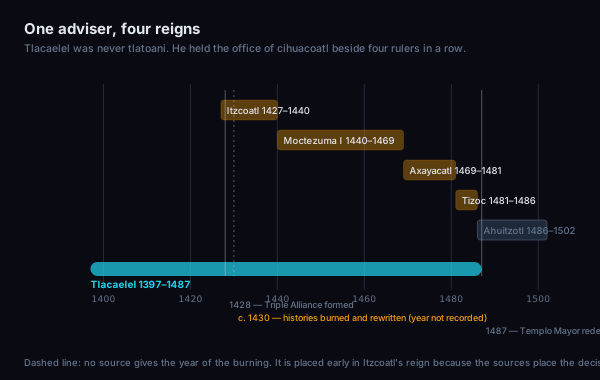
Tlacaelel was Itzcoatl's nephew and Moctezuma I's brother. He held the military office of tlacochcalcatl under Itzcoatl, then the cihuacoatl — an office named for a goddess, held by the ruler's chief counselor — and kept it through Itzcoatl, Moctezuma I, Axayacatl and Tizoc, dying in 1487 as Ahuitzotl came to the throne. Tradition holds he was offered the rulership more than once and refused it.
The figure with this entry lays the reigns out against his life, from the standard dates. The burning is placed early in Itzcoatl's reign with a dashed line, because the sources put the decision in that reign and none gives a year.
WHY THIS SITS IN THE LIBRARY
The vocabulary-narrowing material infers its mechanism — an institution shapes what can be said by shaping what can be recorded. Here the mechanism is not inferred. The institution said what it was doing and why, and a Franciscan's Nahua informants repeated it a century later so it could be written down in a language that survived. The Trent sequence cull is the same shape in Europe, and this entry sits beside it.
It also sits beside the Sun Stone for a reason: the stone's four-dead-worlds cosmology is the official one, the product of this rewrite. The monument and the memo describe the same act from two sides.
WHAT WOULD CHANGE THIS ENTRY
- A primary passage naming Tlacaelel as the author of the burning. None is known. If one surfaced, the hypothesis row moves up a tier; until then it does not.
- The Códice Matritense folio itself, read rather than quoted through León-Portilla. Queued for the verification batch.
- Durán's reliability on the flower wars. He wrote in the 1570s–80s from Nahua sources; the attribution is his. A Nahuatl-language source for the xochiyaoyotl as deliberate policy would strengthen it; its absence is noted.
- A Nahua reader's correction. Nahuatl has over a million speakers. Corrections from inside the tradition are invited and get made.
SOURCES
| Source | Type | Note |
|---|---|---|
| Sahagún, Códice Matritense del Real Palacio, VIII, fol. 192v | Primary | The burning and its stated reason, in Nahuatl from Nahua informants |
| León-Portilla, Aztec Thought and Culture: A Study of the Ancient Nahuatl Mind | Academic | Quotes the passage (p. 155); attributes the instigation to Tlacaelel with his own caveat |
| Durán, Historia de las Indias de Nueva España | Primary (colonial) | Tlacaelel's ideology, the flower wars, the increase in sacrifice |
| Chimalpahin, Annals | Primary (Nahua) | Tlacaelel's offices and dates |
Archive: this is the second entry of the Aztec series (docs/research/AZTEC_COMIC_SERIES_PLAN_2026-09-29.md);
the figure is generated by scripts/generate-mesoamerican-figures.mjs.
RELATED ENTRIES
- The Sun Stone — the official cosmology this rewrite produced, carved
- The Trent Sequence Cull — the same act, in Europe, with the minutes
- The Church Modes — what leaves the syllabus stops being the default
- Media Control — the modern instance of deciding what the people should know
Second entry of the Aztec series, and its spine. A state decided which past its people could have, said why, and the reason was written down. The Library exists to notice when that happens.
Appears in
- Tenochtitlan · exhibit
- Deep time spine · The Mexica burn their histories, text
Further reading
- Aztec Thought and Culture · León-Portilla, 1963
Links go to Bookshop.org, which supports independent bookstores. We may earn a commission, at no cost to you.
Related entries
- The Sun Stone
- The Trent Sequence Cull · card only
- The Church Modes · card only
Civilizational Science
Energy, food, money and the long patterns underneath them. Every claim carries its source and its evidence tier. Free, and it stays free.
No charge, and no paywall on the dispatches. Unsubscribe in one click.