Viśvarūpa-darśana
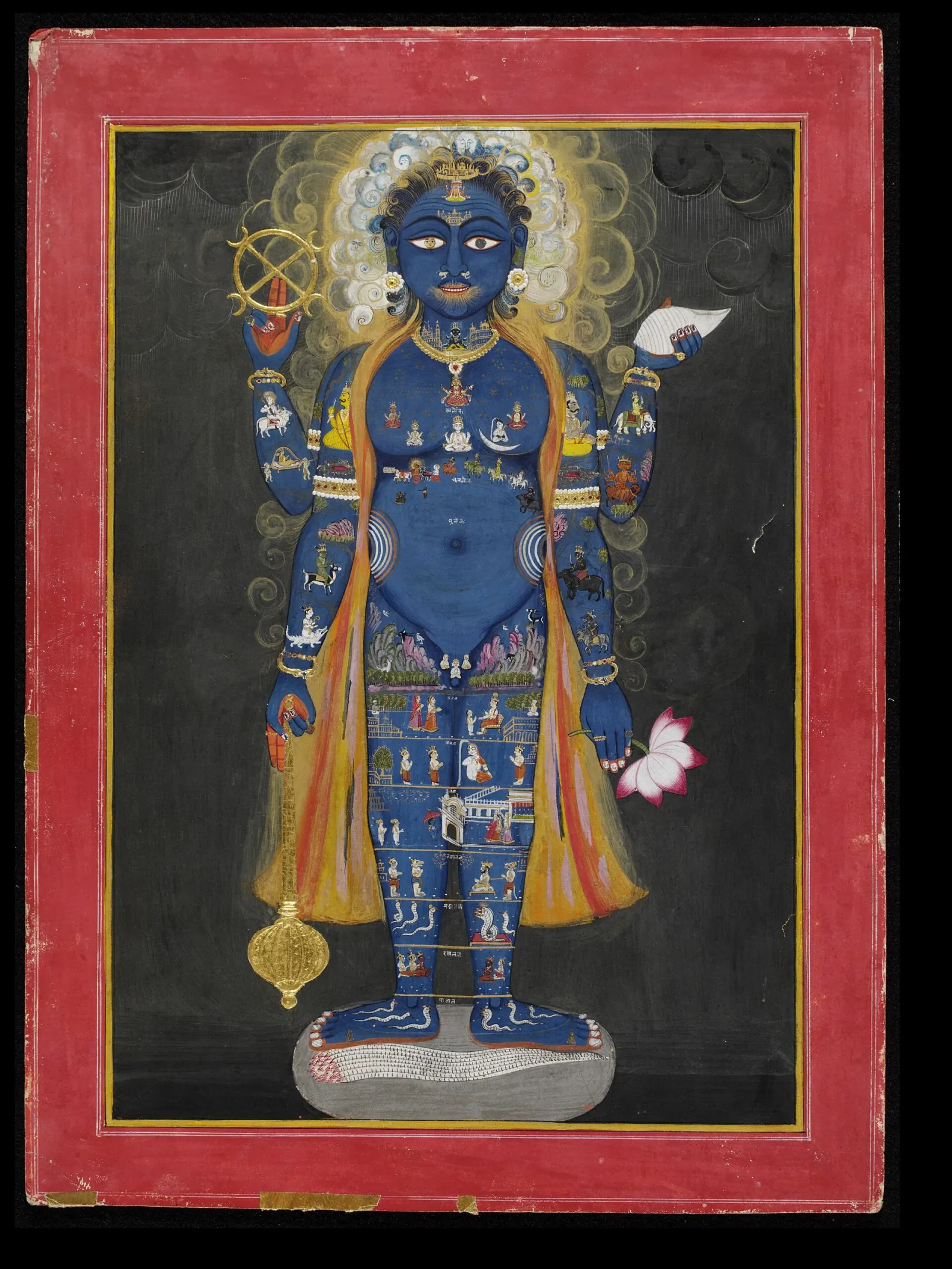
A warrior asks to see what he has been talking to. He is told his eyes are the wrong instrument, is given different ones, and then cannot bear what he sees.
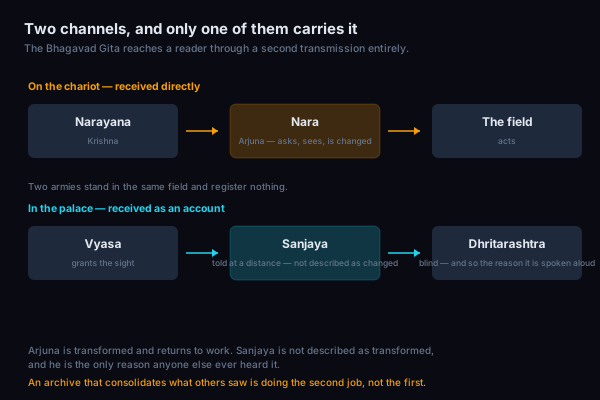
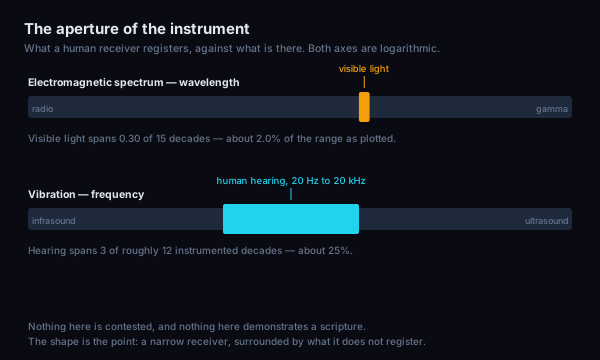
Chapter 11 of the Bhagavad Gita locates the limit in the receiver rather than in the phenomenon, and corrects it by a gift rather than by effort. That is a precise epistemological claim: something is present and unregistered, the failure is instrumental, and an upgraded instrument produces an experience the observer is not equipped to integrate. The accompanying figure makes the modern half of the comparison without mysticism — visible light occupies about 2 percent of the electromagnetic spectrum as conventionally plotted. Nothing in the figure demonstrates the chapter; the shape is the same in both, which is the reason they sit together. Two structural details are easy to read past: Arjuna alone sees it while two armies in the same field register nothing, and the text reaches its reader through Sanjaya, who is told at a distance and whose job is to carry it to someone who cannot see.
- Bhagavad Gita, chapter 11 (within the Bhishma Parva of the Mahabharata)
- Verse 11.8 — divya-cakṣus, the eyes are given rather than earned
- Verse 11.32 — kālo smi loka-kṣaya-kṛt, "I am time, the destroyer of worlds" — The Sanskrit says time, not death; Oppenheimer's Trinity rendering is the familiar English one
- Verse 11.45 — Arjuna asks for the familiar form to return