Nezahualcoyotl
The poet-king who built a temple to one imageless god is a portrait painted by his own great-great-grandson in the 1620s. The sixteen-kilometer dike is in the ground.
Also known as: Netzahualcoyotl · Poet-king of Texcoco · Albarradón · Tloque Nahuaque · Texcoco
NEZAHUALCOYOTL — THE ENGINEER, AND THE PORTRAIT PAINTED OVER HIM
UET Library Encyclopedia Entry
| Alignment Score | Tier | Category |
|---|---|---|
| 82% | ENGINEERED | Ancient Traditions |
Classification: Ruler | Hydraulic engineer | Subject of a colonial rewrite Primary Designation: Nezahualcoyotl (1402–1472), tlatoani of Texcoco 1431–1472 Status: The statesman and the engineer are documented. The philosopher-king who worshipped one imageless god is a portrait painted by his own descendant a century and a half later — and modern scholarship says so
EXECUTIVE SUMMARY
Nezahualcoyotl is the Aztec-era figure most often offered as the "not covered" history — the poet-king of Texcoco who wrote of impermanence, built a temple to an unseen god, and stood apart from the sacrificial religion of his allies. Some of that is true. The rest is a case study in exactly the thing this Library exists to notice: a past rewritten by the people who inherited it, for reasons of their own time.
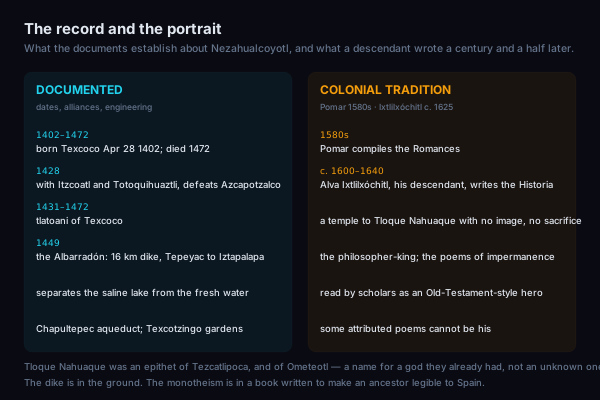
What the record holds is substantial. Born in Texcoco on April 28, 1402, he lost his father and his city to Azcapotzalco as a boy, spent years in exile, and in 1428 joined Itzcoatl of Tenochtitlan and Totoquihuaztli of Tlacopan to defeat the Tepanec ruler Maxtla — the founding of the Triple Alliance. He ruled Texcoco from 1431 until his death in 1472. And in 1449, after a flood in Moctezuma I's reign, he designed the Albarradón — a dike sixteen kilometers long, from Tepeyac to Iztapalapa, of wooden pilings packed with stone and earth, that held back the saline waters of Lake Texcoco and kept the fresh water on Tenochtitlan's side. It stood until the Spanish broke it. He also built the Chapultepec aqueduct and the gardens at Texcotzingo.
That is a hydraulic engineer and a statesman, and it is documented.
The philosopher-king is a different matter, and this entry keeps him on a different tier.
THE RECORD
| Claim | Status | Source |
|---|---|---|
| Born April 28, 1402, Texcoco; died 1472 | DOCUMENTED | Standard reference; Codex Xolotl for the lineage |
| 1428: alliance with Itzcoatl and Totoquihuaztli; Azcapotzalco defeated | DOCUMENTED | Multiple Nahua and colonial sources |
| Tlatoani of Texcoco 1431–1472 | DOCUMENTED | same |
| The Albarradón, 1449: 16 km, Tepeyac to Iztapalapa, separating saline from fresh water | DOCUMENTED | Colonial chronicles; the structure is archaeologically attested and its course is mapped |
| Chapultepec aqueduct; Texcotzingo gardens and baths | DOCUMENTED | same; Texcotzingo is a surveyed site |
The dike is worth dwelling on, because it is the achievement that nobody had to invent. Tenochtitlan sat on an island in a lake that was saline on one side and fed by fresh springs on the other, and it flooded. The Albarradón solved both problems with one wall. It is the largest hydraulic work in pre-Hispanic Mesoamerica, it was proposed by the ruler of an allied city for the benefit of the capital, and it bound the alliance together in the most durable way available: shared infrastructure.
THE PORTRAIT
The Nezahualcoyotl most people meet is the one in Fernando de Alva Ixtlilxóchitl's Historia de la nación chichimeca, written around 1625 — by his great-great-grandson, a colonial mestizo chronicler writing in Spanish for a Spanish audience — and in Juan Bautista Pomar's Romances de los señores de la Nueva España, compiled in the 1580s. In those pages he is:
- A monotheist who built a temple to Tloque Nahuaque, "the Lord of the Near and the Nigh" — a temple with no image and no sacrifice, to a god he conceived as the unrepresentable ground of all things
- A poet whose verses on the brevity of life survive
- A lawgiver and philosopher standing apart from the sacrificial cult of his Mexica allies
What scholarship says about this. The Wikipedia summary of the current consensus is blunt, and it matches the specialist literature: modern historians agree that the ideas described by Pomar and Ixtlilxóchitl are of obvious European origin, and that some poems historically attributed to the monarch could not have been produced by him, having a nature of thought foreign to pre-Columbian Mesoamerica. Authorship remains a subject of intense debate.
Two specific corrections the tradition needs:
- Tloque Nahuaque was not an unknown god. It was an epithet of Tezcatlipoca, and — in León-Portilla's reading — of Ometeotl, the dual creator. A name for a god the Nahua already had, not a monotheist's discovery.
- Ixtlilxóchitl had a project. Recent scholarship (Kauffmann; Lee) reads the Historia as a strategic construction of a Europeanized past, in which his ancestor becomes a king in the Old Testament mold — wise, lawgiving, groping toward the one God — so that the Texcocan royal line would be legible, and creditable, to the colonial order that now judged it.
That is not a reason to discard the portrait. It is a reason to file it correctly: as a document of the 1620s about the 1450s, which tells you a great deal about what a descendant of a conquered dynasty needed his ancestor to have been.
WHY THIS SITS IN THE LIBRARY
The Tlacaelel entry shows the Mexica rewriting their own past under Itzcoatl. This entry shows the rewrite happening again, two centuries later, from the other direction: not a state making its people a chosen nation, but a colonial heir making his ancestor a philosopher the conquerors could respect. Same act, opposite motive, and in both cases the rewrite is now better known than the thing it replaced.
The Library's rule from the folk-etymology work applies here without change: keep the layer, name the seed, verify against the record. The seed is real — a poetic tradition existed, Texcoco was a cultural center, the Romances preserve genuine Nahuatl verse. The portrait grew on that seed, and the entry says which is which.
WHAT WOULD CHANGE THIS ENTRY
- A pre-conquest source for the Tloque Nahuaque temple — a pictorial or Nahuatl attestation independent of Pomar and Ixtlilxóchitl. None is known. If one surfaced, the portrait row moves up a tier.
- Attribution work on the Romances and Cantares Mexicanos. Which poems, if any, can be placed in the fifteenth century on linguistic grounds. That is a live scholarly question; this entry does not pretend to settle it.
- The Albarradón's archaeology — its surveyed course and construction details, cited from the fieldwork rather than from the chronicles.
- A Nahua reader's correction. Nahuatl has over a million speakers; this is a living tradition. Corrections from inside it are invited and get made.
SOURCES
| Source | Type | Note |
|---|---|---|
| Alva Ixtlilxóchitl, Historia de la nación chichimeca | Primary (colonial, c. 1625) | The portrait — by his great-great-grandson |
| Pomar, Romances de los señores de la Nueva España | Primary (colonial, 1580s) | The poems, as compiled |
| Codex Xolotl | Primary (pictorial) | The Texcocan royal lineage |
| León-Portilla, Aztec Thought and Culture | Academic | Tloque Nahuaque as epithet of Ometeotl |
| Kauffmann, The Legacy of Rulership in Fernando de Alva Ixtlilxochitl's Historia de la nación chichimeca | Academic | The Europeanized-ancestor reading |
| Lee, "Alva Ixtlilxochitl's Colonial Mexican Trickster Tale," Colonial Latin American Review 23:1 | Academic | same |
| Studies of the Valley of Mexico hydraulic system | Academic | The Albarradón's date, length and function |
Archive: third entry of the Aztec series (docs/research/AZTEC_COMIC_SERIES_PLAN_2026-09-29.md);
figure by scripts/generate-mesoamerican-figures.mjs.
RELATED ENTRIES
- Tlacaelel — the first rewrite, by the state, in the 1430s
- The Sun Stone — the official cosmology
- Government and Cybernetics — steering, applied to a lake
Third entry of the Aztec series. The dike is in the ground. The monotheism is in a book written to make an ancestor legible to Spain. Both are history; only one of them is his.
Appears in
- Tenochtitlan · exhibit
Further reading
- Aztec Thought and Culture · León-Portilla, 1963
Links go to Bookshop.org, which supports independent bookstores. We may earn a commission, at no cost to you.
Related entries
Civilizational Science
Energy, food, money and the long patterns underneath them. Every claim carries its source and its evidence tier. Free, and it stays free.
No charge, and no paywall on the dispatches. Unsubscribe in one click.