The Mexica
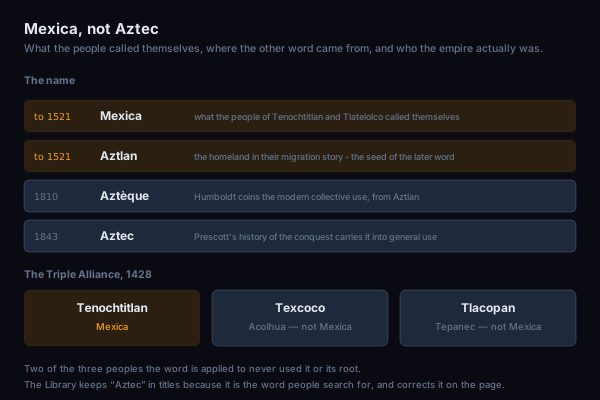
They called themselves the Mexica. "Aztec" comes from Aztlan, the homeland in their migration story, and its modern use was coined by Alexander von Humboldt in 1810 and spread by Prescott in 1843. Two of the three peoples in the empire never used it.
Also known as: Aztec · Aztecs · Culhua-Mexica · Aztlan · Triple Alliance · Mexica not Aztec
THE MEXICA — THE PEOPLE, AND THE WORD THAT REPLACED THEIR NAME
UET Library Encyclopedia Entry
| Alignment Score | Tier | Category |
|---|---|---|
| 86% | ENGINEERED | Ancient Traditions |
Classification: Ethnonym | Historiography | The correction the whole Aztec series opens with Primary Designation: Mexica (Mēxihcah), also Culhua-Mexica — the people of Tenochtitlan and Tlatelolco The other word: "Aztec," from Aztlan, in modern collective use since 1810 Status: The endonym and the dates are documented. The origin of the name Mexica itself is not settled, and the entry says so
EXECUTIVE SUMMARY
The people this series is about did not call themselves Aztecs. They called themselves the Mexica — the people of the island cities Tenochtitlan and Tlatelolco — and, tracing their lineage through Culhuacan to Toltec prestige, the Culhua-Mexica. The word that replaced their name in every textbook comes from Aztlan, the homeland in their migration story, and its modern use was originated by Alexander von Humboldt in 1810 as a collective label for everyone linked by trade, custom, religion and language to the Mexica state. William Prescott's 1843 history of the conquest carried it into general use, and nineteenth-century Mexican scholars adopted it to separate the pre-conquest people from modern Mexicans.
That matters beyond tidiness, for two reasons. First, the empire was a Triple Alliance of three peoples — the Mexica of Tenochtitlan, the Acolhua of Texcoco, and the Tepanec of Tlacopan — and two of the three were never Mexica at all. "Aztec" flattens an alliance into a tribe. Second, "Aztec" is the door through which the Maya walk in: the Long Count, 2012, the "end of the calendar," none of which belong to any of these peoples. The word invites the conflation, and the Library's Sun Stone entry shows how deep it runs.
The Library uses "Aztec" in titles because it is the word people search for, and corrects it on the page. That is a deliberate choice, made here once, so the series does not have to make it in every frame.
THE NAME, TIERED
| Claim | Status | Source |
|---|---|---|
| The self-designation was Mexica (Culhua-Mexica) | EMPIRICAL | Nahuatl sources; standard reference |
| "Aztec" derives from Aztlan, the migration-story homeland | DOCUMENTED | Standard reference; the derivation is uncontroversial, the location of Aztlan is not |
| Humboldt originated the modern collective use, 1810 | EMPIRICAL | Vues des Cordillères (1810); standard reference |
| Prescott's 1843 History of the Conquest of Mexico carried it into general use | EMPIRICAL | Publication record |
| The Triple Alliance was Mexica + Acolhua + Tepanec | EMPIRICAL | Standard reference |
| The origin of the word Mexica itself | CONTESTED | Several derivations proposed (from a tutelary name, from mētztli "moon" + xictli "navel," others); no consensus |
The last row is the one to notice. The people's own name has no settled etymology, and this entry does not supply one. The folk-etymology rule from the etymology cluster applies: where the seed of a derivation is real, name it; where the derivation is unsettled, say that rather than pick.
WHO THEY WERE, BRIEFLY
Late arrivals in the Valley of Mexico — the migration story has them leaving Aztlan and arriving after the great cities of the valley were already old — the Mexica settled an island nobody else wanted in 1325, served as tributaries of Azcapotzalco, and in 1428 joined Texcoco and Tlacopan to break that power. Within a reign they had rewritten their own history to make themselves a chosen people (see Tlacaelel), and within a century they were the dominant partner in an alliance that drew tribute from most of central Mexico. Tenochtitlan by 1519 was larger than any city in Spain.
They were one people among many in the alliance and the valley. The Acolhua of Texcoco had their own poet-king (see Nezahualcoyotl); the Tepanec of Tlacopan had been the power the alliance was formed against, under a different branch. "Aztec" erases those distinctions, which is why the series uses the specific names wherever a specific people is meant.
WHAT THIS ENTRY IS FOR
It is the correction the series opens with, given its own page so that every other entry and every video can point at it once instead of re-explaining it. When a script says Mexica, this is the citation. When a viewer asks why the exhibit is titled Tenochtitlan and the series is called Aztec, this is the answer.
WHAT WOULD CHANGE THIS ENTRY
- A settled etymology of Mexica. None is expected; if one emerges, the contested row changes.
- The exact Humboldt passage in Vues des Cordillères, cited by page.
- A Nahua reader's correction. Nahuatl has over a million speakers; the endonym is theirs, not the Library's. Corrections from inside the tradition are invited and get made.
SOURCES
| Source | Type | Note |
|---|---|---|
| Humboldt, Vues des Cordillères et monumens des peuples indigènes de l'Amérique | Primary | 1810; the modern collective use |
| Prescott, History of the Conquest of Mexico | Primary | 1843 |
| Wikipedia, "Mexica" and "Aztec" | Reference | The endonym; Humboldt and Prescott; the Aztlan derivation; the alliance's composition |
| National Geographic, "Who were the Aztec, really?" | Reference | The terminological history |
Archive: seventh entry of the Aztec series; figure by scripts/generate-mesoamerican-figures.mjs.
RELATED ENTRIES
- The Sun Stone — where the Maya conflation does its damage
- Tlacaelel — the rewrite that made the Mexica a chosen people
- Nezahualcoyotl — an Acolhua, not a Mexica, and the alliance's second city
- Government and Cybernetics — another case of a word carrying a history nobody hears
A name is the first thing a record gets right or wrong. This one has been wrong in every textbook since 1843, and the people it belongs to are still here to say so.
Appears in
- Tenochtitlan · exhibit
- Deep time spine · Tenochtitlan founded, text
Related entries
Civilizational Science
Energy, food, money and the long patterns underneath them. Every claim carries its source and its evidence tier. Free, and it stays free.
No charge, and no paywall on the dispatches. Unsubscribe in one click.